N-400 time outside the United States: find every trip and count the days
Part 8 of Form N-400 asks for every trip outside the United States that lasted more than 24 hours in the last 5 years, with the date you left, the date you came back and the countries you went to. USCIS counts the day you leave and the day you return as days in the US. Rebuild the list from your photos, boarding passes and booking emails, then check it against CBP’s own record of your entries and exits.

Ricordo · Five years of trips, with their datesFree on the App Store, for iPhone and iPad
Download on the App Store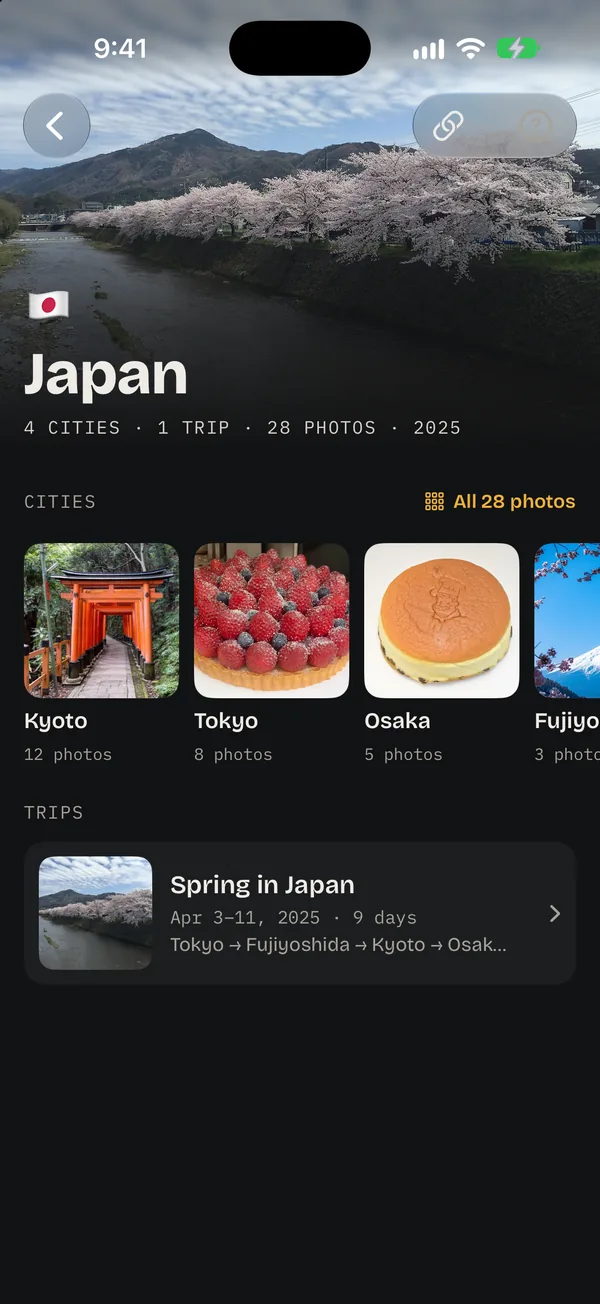
What the N-400 asks about your trips
In the current edition of Form N-400 (01/20/25), your trips are in Part 8. Time Outside the United States. It’s a table with a row for each trip:
- Date You Left the United States, as mm/dd/yyyy.
- Date You Returned to the United States.
- Countries to Which You Traveled.
Applying on the general 5-year basis, you list every trip in the last 5 years; the instructions give the period for other routes, such as the 3-year route for spouses of US citizens. Start with your most recent trip and work backwards. Day trips, where the whole trip was over within 24 hours, stay out of the table. If you run out of rows, the rest go in Part 14. Additional Information.
Check the edition date at the bottom of the form you download from uscis.gov. Part numbers can move between editions, and every page you send has to be from the same one.
The two rules your trips are checked against
Your trips matter for two separate requirements, and you need both:
| Requirement | 5-year route | 3-year route, married to a US citizen |
|---|---|---|
| Physical presence: days actually in the US | At least 913 days (30 months) of the 5 years | At least 548 days (18 months) of the 3 years |
| Continuous residence: no long breaks | 5 years as a permanent resident | 3 years as a permanent resident |
- Physical presence is a count: at least half the period has to be spent in the US.
- Continuous residence is about long trips. An absence of more than 6 months but less than a year is presumed to break it, though you can show it didn’t, for example by keeping your job, your home and your family in the US. An absence of a year or more breaks it, apart from narrow exceptions.
How USCIS counts a trip
USCIS counts the day you leave and the day you return as days in the US. A trip that left on March 1 and came back on March 10 is 8 days abroad, not 10. Add up the days abroad on every trip in the period, and what’s left is your days present.
This is a summary of the N-400 instructions and the USCIS Policy Manual as they stood in November 2026. Check the official guidance on uscis.gov for your own case before you file.
To add it all up, put your trips into the free absence calculator. It counts the whole days abroad on each trip and your days present for the 5- and 3-year routes, and marks any trip of more than 6 months.
Get your official dates from CBP
US Customs and Border Protection (CBP) keeps a record of your arrivals and departures. There are two ways to see it, and only one works once you have a green card:
- The I-94 website (i94.cbp.dhs.gov) has View Travel History, with US arrivals and departures for the past 10 years. It’s for visitors and other nonimmigrants: CBP says US citizens and lawful permanent residents can’t retrieve their travel history there.
- A FOIA request to CBP is the way for permanent residents. CBP’s travel records go back to 1982.
- Start a request to CBP online, through its SecureRelease portal or FOIA.gov, which CBP asks people to use.
- Give your full name, date of birth and address, and anything that helps find your records, such as your A-number and the passports you travelled on.
- Ask for exactly what you need: your arrival and departure records from one date to another.
- Show it’s you, with a signed Certification of Identity or a statement under penalty of perjury.
Ask well before you plan to file, as it isn’t instant. When the records arrive, compare them with your own list. No record is perfect: CBP says its online travel history misses most land border crossings, so look closely at drives to Canada or Mexico.
Rebuild the list from your own records
You need your own list anyway, to fill in the form and to check CBP’s against. Work through the period one source at a time:
- Your photos. The first and last photo abroad bracket each trip, and their locations name the countries. Finding your travel history from photos shows how, by hand or with an app.
- Your flights. Boarding passes, airline account histories and booking emails give exact days. In Mail, search for “boarding pass”, “itinerary” or “e-ticket”. In Wallet, tap ⋯ and then Expired to see old boarding passes.
- Drives and trains. A car trip to Canada or Mexico often leaves no ticket. Card statements show where you were spending, day by day.
- Passport stamps, from the countries that still stamp.
- The gaps. For a month you can’t account for, see finding out where you were on a certain date.
Your first photo abroad is usually a few hours after you left, and your last one a little before you got home. Use your tickets for the exact days on the form.
Let your photos find the trips
Going through 5 years of photos by hand takes an afternoon. Ricordo does the first pass for you: it reads where and when each photo was taken, on your iPhone, learns where home is, and lists every trip away with its dates and countries.
- Every trip, with dates. A trip starts when your photos are more than 50 km from home and ends after more than two days without photos away, or a day back home. Tap Why is this a trip? on any trip to see where its dates come from.
- Every country, with when you first went and every trip there.
- Your flights, read from the boarding passes in your screenshots: see the flight log guide.
- Long stays, too. A stay away of more than 60 days shows in the Trips list as a long stay, with I lived here in case it was home for a while, like the place you lived before moving to the US. If it wasn’t home, it’s a trip on the N-400: put it on the form.
Ricordo gives you the trips and their dates. It doesn’t fill in the form or count your days: check each trip against your tickets, then put the dates into the absence calculator.
Questions
Do I list trips shorter than 24 hours on the N-400?
No. Part 8 says to leave out day trips where the whole trip was over within 24 hours. List every trip longer than that, most recent first.
How many days can I spend outside the US before applying for citizenship?
You need to have been in the US for at least 913 days of the 5 years before you apply (548 of 3 years on the spouse route). Separately, one trip of more than 6 months is presumed to break continuous residence, and one of a year or more breaks it.
Does the day I left count as a day outside the US?
No. USCIS counts the day you leave and the day you return as days in the US, so a trip from March 1 to March 10 is 8 days abroad.
Can I get my travel history from the I-94 website with a green card?
No. CBP says US citizens and lawful permanent residents can’t retrieve their travel history there. Ask CBP for your entry and exit records with a FOIA request, through SecureRelease or FOIA.gov.
How do I find trips I’ve forgotten?
Go through your photos year by year, then your boarding passes, booking emails and card statements. Ricordo finds the trips in your photo library on your iPhone and lists each with its dates and countries.